You walk into one room and it feels perfectly cool. You step into the next and it feels like the AC is not even running. If this sounds familiar, your ducted split AC system is trying to tell you something.Uneven cooling is one of the most common complaints from homeowners, office managers, and facility teams who rely on ducted split systems to maintain comfortable temperatures across multiple rooms or zones. The problem is rarely the thermostat setting. In most cases, the real cause is buried inside the system itself, hidden in dirty ducts, clogged coils, and contaminated filters that have not been properly cleaned in months or longer.
Ducted split AC deep cleaning is not something most people think about until the system starts to visibly underperform. But by the time you notice hot spots, weak airflow, or strange odors, the buildup inside your system has usually been accumulating for quite a while.
This guide covers exactly what causes uneven cooling, the five clearest signs your ducted split AC needs deep cleaning, and why professional ducted AC maintenance is the most effective solution for restoring reliable, consistent performance.
How Does a Ducted Split AC System Work?
Before understanding what goes wrong, it helps to understand how a ducted split AC system is designed to work.
A ducted split system consists of two main units. The indoor unit, typically installed in the ceiling or a concealed space, houses the evaporator coil, fan, and air handler. The outdoor unit contains the compressor and condenser coil. These two units are connected by refrigerant lines and electrical wiring.
Air from inside the building is drawn into the indoor unit, passed over the cold evaporator coil to remove heat, and then pushed through a network of ducts to vents located in each room or zone. The return air then comes back through return grilles and the cycle repeats.
For this system to distribute air evenly and efficiently, every component in the chain needs to be clean and unobstructed. The filters need to be clear. The coils need to be free of dust and debris. The ducts need to be open and sealed correctly. The vents need to be unblocked.
When any part of this chain becomes dirty or restricted, the entire system suffers. Airflow drops, some rooms receive less conditioned air than others, and the system starts working harder to compensate. This is where uneven cooling begins, and why regular ducted split AC cleaning is essential for consistent performance.
Why Uneven Cooling Happens in Ducted Split AC Systems
Uneven cooling does not usually have a single cause. It tends to develop gradually as multiple factors combine to reduce system performance.
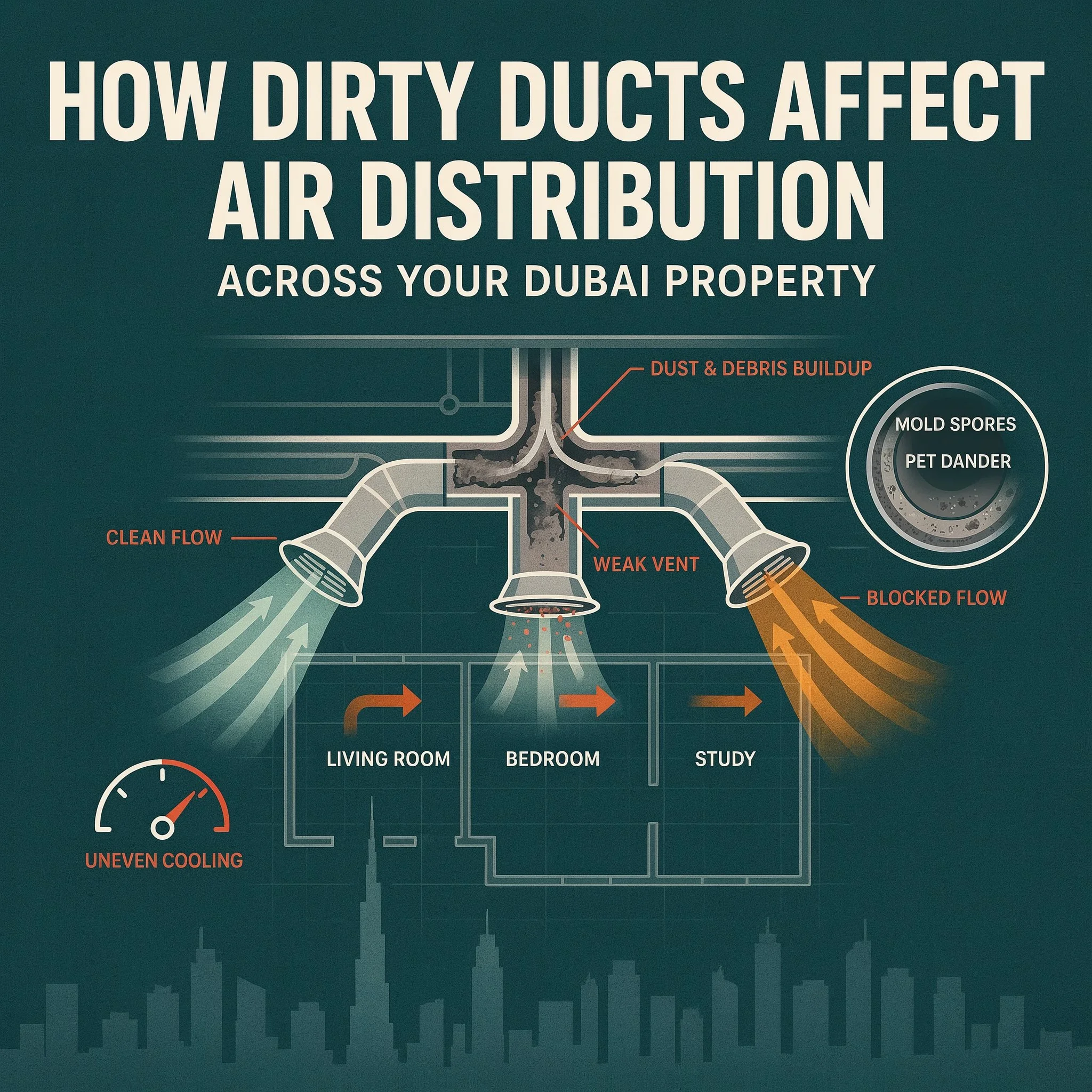
Blocked ducts are one of the most direct causes. When dust, debris, or even pests obstruct sections of the ductwork, airflow to those areas drops significantly. Rooms connected to blocked duct runs will feel noticeably warmer than rooms with clear airflow.
Dirty filters restrict the volume of air entering the system. When not enough air passes through the filter, the indoor unit cannot circulate sufficient conditioned air throughout the duct network. Some zones receive adequate airflow while others receive very little.
Clogged evaporator coils reduce the system’s ability to cool air effectively. A thick layer of dust on the coil surface insulates it against heat transfer, which means the air passing over it is not cooled as much as it should be. The result is air that reaches the vents at a higher temperature than intended.
Airflow imbalance can develop when dampers inside the duct system are incorrectly set or when the duct layout itself is not balanced to deliver equal volumes of air to each zone.
Mold and dust buildup inside ducts creates physical resistance to airflow while also contaminating the air that does pass through. In humid environments, mold colonies can grow rapidly inside duct systems and spread particles through every connected room.
Poor maintenance is the common thread running through all of these causes. Systems that are regularly serviced and professionally cleaned simply do not develop these problems at the same rate as neglected ones.
5 Signs Your Ducted Split AC Needs Deep Cleaning
These are the five signs that most clearly indicate your ducted split system is overdue for professional deep cleaning.
Uneven Cooling in Different Rooms
The most obvious sign is the one that prompted you to read this in the first place. When some rooms feel comfortably cool and others feel warm or stuffy despite all vents being open, the system is not distributing air evenly.
Hot and cold spots across different areas of a property indicate that airflow is being disrupted somewhere in the duct network. Dirty ducts, blocked vents, or contaminated coils all reduce the volume of conditioned air reaching specific zones.
In office buildings and commercial spaces, uneven cooling creates real productivity problems. Employees in warmer zones become uncomfortable, which affects focus and performance. In retail environments, uncomfortable temperatures directly affect the customer experience.
This is one of the clearest indicators that ducted split AC deep cleaning is needed. Once the ducts are cleared and the coils are cleaned, airflow balances out and temperature distribution improves across all connected rooms.
Weak Airflow From Vents
Put your hand near a vent when the system is running. If the airflow feels noticeably weaker than it used to, the system has a restriction somewhere in the airflow path.
Dust blocked ducts are a frequent cause. Over time, fine particles settle inside duct runs and gradually reduce the internal diameter available for airflow. The longer the system runs without cleaning, the more this buildup accumulates.
Fan restrictions inside the indoor air handler can also reduce airflow. Dust on fan blades changes their aerodynamic profile and reduces the volume of air they can move. This affects every vent connected to that unit.
Dirty filters compounding the problem are extremely common. A filter that has not been cleaned or replaced will reach a point where it acts as a near solid barrier to airflow. The system still runs, but barely any air makes it through.
Weak airflow is not just a comfort issue. It forces the system to run for longer periods to achieve the desired temperature, which increases energy consumption and accelerates component wear.
Bad Odors Coming From the AC
When you turn on your ducted split system and notice a musty, stale, or unpleasant smell filling the room, that odor is coming from inside your AC system.
Mold growth inside ducts and on the evaporator coil is the most common source. Mold thrives in the cool, dark, damp environment inside a ducted AC system, particularly when the system runs in humid conditions. Once mold establishes itself on the coil or inside the ductwork, every cycle of the fan spreads spores and particles throughout the building.
Bacteria buildup contributes to similar odors and poses its own health concerns. Contaminated drain pans and moisture inside ducts create ideal conditions for bacterial growth.
Indoor air quality deteriorates significantly when these contaminants are present. For homes with children, elderly residents, or anyone with respiratory conditions, this is a serious health concern. For businesses, it affects the wellbeing of everyone in the building.
Professional ducted AC mold cleaning eliminates these contaminants at the source. Surface cleaning alone is not sufficient. The contamination needs to be addressed deep inside the coil and duct system where it actually originates.
Higher Electricity Consumption
If your electricity bills have been creeping upward without any obvious reason, your ducted split AC system may be the cause.
A dirty AC system works much harder than a clean one to deliver the same cooling output. Dirty coils reduce heat transfer efficiency. Blocked ducts increase resistance to airflow. Clogged filters restrict the air entering the system. Each of these issues forces the system to run longer and draw more power to compensate.
The extra energy consumption is not trivial. An AC system operating with significantly dirty components can consume considerably more electricity than the same system in clean condition. That difference accumulates across every cooling cycle, every day, throughout the entire cooling season.
Improving AC cooling efficiency through deep cleaning reduces the workload on the system and brings energy consumption back to normal levels. Many businesses find that a professional service delivers a measurable reduction in electricity costs within the first billing cycle after cleaning.
Excess Dust and Allergy Symptoms Indoors
If surfaces in your home or workplace seem to accumulate dust unusually quickly, or if occupants are experiencing more frequent allergy symptoms, sneezing, or respiratory discomfort, the AC system may be the source.
Dirty air ducts circulate whatever is inside them throughout the entire building. Dust, allergens, mold spores, and other particles that have accumulated inside the ductwork get pushed out through every vent with every cycle. The more contaminated the ducts, the more particles are released into the living or working environment.
Dust buildup in rooms happens faster when the AC system is spreading contaminants rather than simply conditioning the air. Occupants who spend extended time in these environments often notice increased allergy symptoms, eye irritation, and general discomfort.
Air duct sanitization as part of a full deep clean removes accumulated contaminants from the duct interior, which directly improves the quality of air being delivered to every room.
Hidden Problems Caused by Dirty Ducted Split AC Systems
Beyond the five visible signs, dirty ducted AC systems create hidden problems that can be far more expensive to fix than the cleaning itself.
Mold growth spreads progressively. Once it establishes on the evaporator coil or inside the ductwork, it continues to expand with every operating cycle. By the time it is discovered, it may have spread through a significant portion of the duct network.
Bacteria buildup in drain pans and on internal surfaces creates ongoing hygiene risks, particularly in commercial environments where regulatory compliance around air quality may apply.
Reduced HVAC lifespan is one of the most significant long term costs. A system that constantly operates under stress from restricted airflow and poor heat transfer wears out its components years before their expected service life. Compressors, fan motors, and control systems all suffer under these conditions.
Water leakage around the indoor unit often traces back to dirty coils. When ice forms on a contaminated evaporator coil and then melts in volume, the drain system can be overwhelmed, causing water to leak into ceiling spaces, walls, or onto floors.
Frozen coils result from severely restricted airflow caused by dirty filters or heavily contaminated evaporator coils. A frozen coil is an emergency condition that requires immediate attention and can indicate serious damage to the refrigerant circuit.
Compressor strain is the most costly outcome of all. The compressor is the most expensive component in any AC system, and it is also the component most affected by the increased workload caused by dirty coils and restricted airflow. Compressor replacement or failure often signals the end of a system’s useful life.
How Deep Cleaning Improves Ducted Split AC Performance
The benefits of professional ducted split AC deep cleaning go well beyond simply making the system smell better.
Better airflow is the most immediate result. Once ducts are cleared and filters and coils are cleaned, air moves through the system with the volume and velocity it was designed for. Every vent delivers the airflow it should, and temperature distribution across all zones improves.
Improved cooling efficiency follows directly from cleaner coils. When the evaporator coil surface is free of dust, heat transfer between the air and the refrigerant happens efficiently. The system reaches the target temperature faster and cycles off sooner, reducing run time and energy consumption.
Cleaner indoor air is the health benefit that matters most to occupants. Removing mold, bacteria, dust, and allergens from inside the system means the air circulating through your home or business is genuinely cleaner and safer to breathe.
Odor removal addresses one of the most immediately noticeable improvements. After a thorough clean and sanitization, the musty or stale odors that were coming through the vents disappear completely.
Reduced dust circulation means surfaces in the building stay cleaner for longer. Less frequent dusting, less airborne particulate, and better overall air quality throughout the space.
Longer AC lifespan is the financial benefit. A system that operates cleanly and efficiently under normal load conditions will outlast one that constantly runs under stress. Regular professional cleaning is one of the most cost effective investments in your HVAC equipment.
Better humidity control is a benefit that many people overlook. A clean evaporator coil manages condensation correctly and maintains appropriate indoor humidity levels. A dirty coil struggles with moisture management and can contribute to elevated indoor humidity.
What Is Included in Professional Ducted Split AC Deep Cleaning?
Understanding what a professional service actually involves helps set expectations and confirms why it delivers results that routine maintenance cannot.
Inspection is the starting point. A qualified technician assesses the entire system, including the indoor unit, outdoor unit, ductwork, vents, filters, and drain lines. This step identifies the specific areas requiring attention and any additional issues that need to be addressed.
Filter cleaning or replacement is addressed immediately. Filters are removed, cleaned thoroughly, or replaced depending on their condition. This single step can have an immediate impact on airflow.
Evaporator coil cleaning is one of the most critical elements of the service. Specialised coil cleaning agents are applied to break down dust, grease, and biological contamination on the coil surface. This restores heat transfer efficiency and removes the source of many odor and air quality problems.
Drain line flushing clears blockages in the condensate drainage system. Blocked drain lines cause water to back up and overflow, leading to leaks and potential water damage. Flushing restores proper drainage and prevents this from occurring.
Air duct cleaning removes accumulated dust, debris, and contaminants from inside the duct network. This typically involves specialised equipment to dislodge and extract material from duct runs that cannot be reached by conventional cleaning methods.
Mold treatment is applied where mold or biological contamination has been identified. Professional grade antimicrobial treatments eliminate existing growth and help prevent recurrence.
Sanitization of all internal surfaces, including the air handler housing, fan blades, and vent grilles, removes surface contamination and leaves the system clean throughout.
Performance testing is the final step. The technician restarts the system and checks airflow, temperature differential, and system pressures to confirm that the cleaning has restored proper performance before completing the job.
Why DIY AC Cleaning Is Not Enough
Many property owners attempt to maintain their ducted split systems themselves. While regular filter cleaning is a valuable habit, DIY cleaning has significant limitations when it comes to the deeper issues that affect performance.
Surface cleaning limitations mean that most DIY efforts only address what is visible and accessible. The contamination that causes the most damage, on the evaporator coil, inside duct runs, and in the drain system, is not accessible without proper equipment and training.
Hidden dust and mold deep inside the duct system cannot be reached with a cloth or a household vacuum. Duct cleaning requires specialised equipment to create suction and dislodge material from inside sealed duct runs. Without this equipment, the contamination simply remains.
The risk of damaging AC components is real. Evaporator coil fins are extremely delicate. The wrong cleaning tool or too much pressure can bend or damage fins, reducing airflow and requiring expensive repairs. Using incorrect chemical agents can corrode coil materials and cause refrigerant leaks.
Safety concerns apply to any work involving the electrical and refrigerant components of an AC system. Commercial and residential ducted systems operate at voltages and pressures that require trained technicians to handle safely.
Professional AC cleaning services bring the right equipment, the right products, and the right expertise to address the full depth of contamination in a ducted split system. The result is a clean system that actually performs better, not just one that looks cleaner from the outside.
How Often Should You Schedule Ducted Split AC Deep Cleaning?
The appropriate cleaning frequency depends on the environment the system operates in and the demands placed on it.
Homes in typical residential environments generally benefit from a professional deep clean once a year, with filter cleaning every one to two months. Properties with pets, high occupancy, or residents with allergies may benefit from more frequent servicing.
Offices with standard occupancy and no significant contamination sources are well served by biannual deep cleaning. High occupancy open plan offices may benefit from quarterly servicing due to the volume of airborne particles generated by dense occupancy.
Restaurants and commercial kitchens require much more frequent cleaning due to grease, steam, and cooking byproducts that contaminate ducted AC systems rapidly. Quarterly deep cleaning at a minimum is appropriate for most food service environments.
Commercial buildings with high foot traffic, such as retail stores, shopping centers, and hospitality properties, generate significant airborne contamination from constant human movement. Biannual deep cleaning is a standard recommendation for these environments.
High dust environments including construction adjacent properties, industrial facilities, and manufacturing spaces expose ducted AC systems to aggressive contamination. Monthly or quarterly cleaning may be necessary depending on the severity of the environment.
Seasonal maintenance schedules work well for most residential and commercial properties. Scheduling a deep clean before the peak cooling season ensures the system is operating at full efficiency when it is needed most.
Tips to Prevent Uneven Cooling in Ducted Split AC Systems
Between professional service visits, there are practical steps property owners and facility teams can take to slow down contamination and maintain more consistent performance.
Replace or clean filters on a regular schedule. Filters should be checked monthly and cleaned or replaced before they become heavily loaded. A clean filter is the simplest and most effective way to maintain good airflow through the system.
Schedule preventive maintenance before problems develop. Waiting until the system shows obvious signs of failure is always more expensive than routine servicing. Proactive maintenance catches issues early and keeps the system running efficiently.
Keep vents clean and unobstructed. Regularly wipe vent grilles to remove surface dust, and ensure furniture, curtains, and equipment are not blocking return or supply vents. Blocked vents disrupt the airflow balance across the entire duct network.
Monitor airflow changes and act on them early. If occupants notice that one room has become noticeably warmer or that airflow from a particular vent feels weaker, investigate the cause promptly. Early intervention prevents minor issues from developing into major ones.
Maintain consistent thermostat settings where possible. Extreme and frequent changes to thermostat settings can cause the system to cycle erratically, which stresses components and reduces efficiency over time.
Avoid blocking vents with stored items, furniture rearrangements, or temporary partitions. In commercial environments particularly, it is common for furniture to be moved in ways that obstruct supply or return vents without the facility team being aware.
Why Choose Microcare for Ducted Split AC Deep Cleaning
When it comes to ducted split AC deep cleaning, the quality of the service provider determines the quality of the result. Microcare brings the expertise, equipment, and commitment that commercial and residential clients need to get genuine value from every service.
Our experienced AC technicians have worked across a wide range of ducted split systems in residential properties, office buildings, commercial spaces, and industrial environments. We understand the specific demands of different system types and tailor our approach to the unique requirements of each job.
We use advanced cleaning equipment that goes beyond surface level treatment. Our tools and methods reach inside duct runs, into coil surfaces, and through the entire airflow path to remove contamination at its source. Every service is thorough, not cosmetic.
Our deep sanitization process addresses not just dust and debris but also mold, bacteria, and biological contamination. We apply professional grade treatments that eliminate existing growth and help prevent recurrence, leaving your system genuinely clean and your indoor air genuinely healthier.
Reliable maintenance support means we are not just a one time service provider. Microcare offers structured maintenance programs for residential and commercial clients that keep ducted split systems performing consistently throughout the year, with scheduled visits and detailed service records.
Our residential and commercial expertise means we understand what clean air means for a family home as well as what it means for a busy office, a restaurant, or a healthcare facility. We bring the same standards to every job regardless of property type or size.
Indoor air quality solutions extend beyond cleaning the AC itself. Our team can identify and address sources of contamination that are making your system dirty faster than it should be, helping you maintain better air quality with less frequent intervention.
Preventive maintenance services from Microcare are designed to catch problems before they become failures. We identify early signs of contamination, component wear, and airflow issues during every visit, so you are never caught off guard by an unexpected breakdown.
Final Thoughts
Uneven cooling, weak airflow, strange odors, rising electricity bills, and excess indoor dust are not minor inconveniences. They are clear signals that your ducted split AC system needs professional deep cleaning, and the longer those signals are ignored, the more expensive the eventual consequences become.
Dirty ducts and contaminated coils do not fix themselves. The buildup inside a neglected ducted split system continues to grow with every operating cycle, reducing performance, increasing energy waste, and shortening the life of your equipment.
The good news is that professional ducted split AC deep cleaning restores performance quickly and effectively. Clean coils transfer heat the way they were designed to. Clear ducts distribute air evenly across every room. A sanitized system delivers genuinely clean air to the people who breathe it every day.
Do not wait for a complete breakdown before taking action. If your system is showing any of the signs covered in this guide, or if it has been more than a year since a professional service, now is the right time to act.
Contact Microcare today and schedule a professional ducted split AC deep cleaning service. Our team will assess your system, perform a thorough clean and sanitization, and ensure your cooling is working reliably and efficiently before we leave.

Frequently Asked Questions
Why is my ducted split AC cooling unevenly?
Uneven cooling is usually caused by dirty or blocked ducts, clogged evaporator coils, dirty filters, or airflow imbalances in the duct network. Any of these issues reduces the volume of conditioned air reaching certain rooms while others receive normal airflow. A professional inspection and deep clean typically resolves the problem.
How do I know if my AC needs deep cleaning?
The most common signs include uneven temperatures across rooms, weak airflow from vents, musty or stale odors when the system runs, higher than usual electricity bills, and increased dust or allergy symptoms indoors. If your system is showing any of these signs, a professional deep clean is recommended.
Can dirty ducts affect indoor air quality?
Yes, significantly. Dirty ducts circulate dust, allergens, mold spores, and bacteria through every room connected to the system. Occupants may experience increased allergy symptoms, respiratory discomfort, and general stuffiness. Air duct sanitization as part of a deep clean removes these contaminants and improves the quality of air throughout the building.
How often should ducted AC systems be cleaned?
Most residential properties benefit from a professional deep clean once a year. Offices and commercial spaces typically need biannual servicing. Restaurants, high traffic commercial properties, and industrial environments may require quarterly or more frequent cleaning depending on the level of contamination in the environment.
Is professional AC deep cleaning necessary?
Yes. DIY cleaning only addresses surface level contamination and cannot reach the coils, drain lines, and interior duct runs where the most damaging buildup occurs. Professional cleaning uses specialised equipment and chemical treatments to remove contamination thoroughly, restore system performance, and improve indoor air quality in ways that self cleaning simply cannot achieve.